

I. Introduction
As a crucial component of China's national strategy, the Guangdong-Hong Kong-Macao Greater Bay Area is driving regional economic integration and cross-border cooperation. However, due to the disparities in legal systems among the three regions, cross-border human resource management encounters numerous challenges. The Greater Bay Area encompasses three distinct legal systems: the continental law, common law, and a hybrid legal system. Differences in labor contracts, social security, and labor dispute resolution, among other aspects, have become bottlenecks restricting the efficient flow of human capital.
The existing literature primarily focuses on comparative studies of legal systems and research on multinational talent management, yet there remains a scarcity of studies specifically targeting the Guangdong-Hong Kong-Macao Greater Bay Area. Schuler, Jackson, and Tarique (2011) pointed out that global talent management encounters multiple legal and cultural challenges, while Tarique and Schuler (2010) argued that multinational labor laws impose higher demands on unified management models. Zhu (2024) noted that the conflicts in legal rules among the three regions within the Guangdong-Hong Kong-Macao Greater Bay Area have led to increased labor costs for enterprises. Moreover, the current policies predominantly rely on administrative cooperation and lack the support of a high-level legal framework. Xie (2020) emphasized that when the central government attempts to coordinate the legal systems of the three regions within the Guangdong-Hong Kong-Macao Greater Bay Area, it is prone to falling into the dilemma of "overstepping" or "underperforming," making it challenging to strike a balance between local autonomy and unified rule of law.
This study aims to fill this research gap by uncovering the dynamic causal chain of "legal disparities → transaction costs → corporate responses." It explores how legal coordination mechanisms and micro-level human resource management innovations within enterprises can facilitate the flow of talent capital across the region and promote coordinated economic development. Meanwhile, this paper also places particular emphasis on the pivotal role of vocational education in bridging cross-border labor laws. It proposes that innovations in vocational education can serve as a crucial means to address disparities in labor laws and facilitate the mobility of talent.
II. Disparities in Labor Laws and Associated Challenges
I) Overview of the Labor Legal System
As part of the mainland legal jurisdiction of China, Guangdong Province has established a systematic labor legal framework grounded in national legislation, including the Labor Law of the People's Republic of China (2018), the Labor Contract Law of the People's Republic of China (2007), and the Social Insurance Law of the People's Republic of China (2010). This framework is further supplemented by local regulations, such as the Regulations on Work-Related Injury Insurance in Guangdong Province (2011) and the Regulations on Wage Payment in Guangdong Province (2005), among others. Among them, the Labor Law establishes the fundamental principles governing labor relations, encompassing essential elements such as labor contracts, working hours, wages, and occupational safety. The Labor Contract Law regulates the procedures for the formation, performance, and termination of labor contracts, thereby strengthening the protection of labor rights and interests. The Social Insurance Law mandates the establishment of five major social insurance schemes: pension, medical, work-related injury, unemployment, and maternity insurance. The Regulations on Wage Payment in Guangdong Province clarify provisions regarding wage calculation, payment timelines, and liability for wage arrears, while also instituting a "wage arrears security fund" system. Additionally, the Regulations on Work-Related Injury Insurance in Guangdong Province refine the criteria for work-related injury identification, standards for compensation benefits, and procedures for dispute resolution.
Hong Kong adheres to the common law tradition, characterized by a combination of statutory law and case law. Its labor legal framework centers on key statutes such as the Employment Ordinance (Cap. 57, 1997), the Minimum Wage Ordinance (Cap. 608, 2011), and the Mandatory Provident Fund Schemes Ordinance (Cap. 485, 2000), with an emphasis on contractual freedom and judicial interpretation. Among these, the Employment Ordinance stipulates fundamental provisions concerning employment contracts, wage payments, leave entitlements, and termination compensation, covering full-time, part-time, and temporary workers. The Minimum Wage Ordinance establishes a statutory minimum wage regime, while the Mandatory Provident Fund Schemes Ordinance mandates that both employers and employees contribute 5% of the employee's monthly salary to a Mandatory Provident Fund (MPF) account.
Macao's legal system bears a profound influence from Portuguese law, with its labor legal framework primarily composed of the Labor Relations Law (Law No. 7/2008, 2008), the Social Security System (Law No. 4/2010, 2010), and the Framework Law on Employment Policy and Labor Rights (Law No. 21/2009, 2009). Among these, the Labor Relations Law strictly mandates that dismissal must be based on valid grounds and establishes corresponding compensation standards. The Social Security System institutes a dual-tiered social security framework, encompassing a contributory "Social Security Fund" and a non-contributory "Social Welfare Allowance." Furthermore, the Framework Law on Employment Policy and Labor Rights explicitly prohibits unreasonable discrimination on grounds such as gender, age, or disability, while safeguarding the preferential employment rights of local residents.
The legal systems in the three regions are all committed to safeguarding workers' rights and maintaining market order. However, due to differences in their respective legal traditions, legislative philosophies, and administrative frameworks, various coordination challenges and potential conflicts persist in practical implementation. These issues not only complicate corporate labor management but also create barriers to cross-border labor mobility. Specifically, in the context of talent flow across Guangdong, Hong Kong, and Macao, legal disparities may drive up mobility costs for workers transitioning between different jurisdictions. Vocational education plays a pivotal role in this process. Through vocational education programs, workers can acquire knowledge and understanding of labor regulations across different jurisdictions, enhancing their ability to recognize and navigate legal disparities. This enables them to respond flexibly to varying legal requirements in practical work scenarios. Vocational education not only mitigates compliance risks arising from legal differences for workers but also improves their adaptability and regulatory compliance in cross-border employment contexts. Specifically, vocational education can assist workers in gaining a deeper understanding and mastery of legal provisions across different regions by developing cross-regional labor law courses or specialized training programs. For instance, courses on the formation and termination of labor contracts could be offered, with particular emphasis on the differences in these areas among Guangdong, Hong Kong, and Macao. Additionally, regarding variations in social security systems and labor dispute resolution mechanisms, vocational education can help workers comprehend the regulations of different jurisdictions and provide them with corresponding legal response strategies. Through such an educational system, workers can better adapt to the challenges of the cross-border labor market, enhance their ability to move between different jurisdictions, and provide strong support for the economic integration of the Guangdong-Hong Kong-Macao Greater Bay Area and the development of its cross-border labor market.
II) Reconstruction of Teaching Content for Cross-Jurisdictional Labor Law: Core Differences and Skill Requirements Analysis
Labor law, serving as the institutional cornerstone for regulating labor relations and safeguarding workers' rights, constitutes the core content of human resources management education in the Greater Bay Area. However, the systemic differences in labor laws across Guangdong, Hong Kong, and Macao have created multiple standards in practice. This poses a significant challenge to vocational education: the traditional single-jurisdiction teaching model can no longer equip students with the compliance skills required for cross-regional scenarios. Therefore, specialized practical training modules must be developed to address the following core differences.
Contract Formation and Termination. As the foundational document establishing employment relationships, labor contracts exhibit significant variations across different jurisdictions. Guangdong Province has formulated explicit regulations regarding the form, content, and indefinite-term contracts of labor agreements based on the Labor Contract Law. Specifically, Article 10 mandates that a written labor contract must be concluded upon the establishment of an employment relationship; failure to do so obligates the employer to pay the employee double wages on a monthly basis, as stipulated in Article 82. Concurrently, Articles 12-15 classify contracts into fixed-term, indefinite-term, and task-based contracts. Article 14 mandates that after two consecutive fixed-term contracts are concluded without gross misconduct on the part of the employee, an indefinite-term contract must be entered into. In Hong Kong, under Section 5 of the Employment Ordinance, there is no mandatory requirement for labor contracts to be concluded in written form; oral agreements are deemed valid. However, employers are obligated to provide written terms of employment within one month of an employee's commencement (Section 44A). Employees are classified as having a "continuous contract" (defined as working continuously for 4 weeks with at least 18 hours per week, as per Section 4) to determine their eligibility for long-term employee benefits (such as severance pay and annual leave). In Macao, Article 16(1) of the Labor Relations Law stipulates that all labor contracts must be concluded in writing, clearly specifying core terms including job position, remuneration, and working hours. Article 17 categorizes contracts into fixed-term (with a maximum duration of 2 years) and indefinite-term contracts; if a fixed-term contract is renewed for more than two years, it automatically converts into an indefinite-term contract (Article 17(4)).
The termination of labor contracts represents one of the most sensitive and intricate aspects of labor relations management. Notable disparities exist among Guangdong, Hong Kong, and Macao in terms of the legal grounds for contract termination, criteria for economic compensation, and dismissal procedures. These differences pose considerable legal risks and operational challenges for enterprises when engaging in cross-regional employment practices. In Guangdong Province, the conditions for contract termination and economic liabilities are stipulated in accordance with the Labor Contract Law. Enterprises can only terminate contracts under the statutory circumstances outlined in Article 39 (termination due to employee fault), Article 40 (termination without employee fault), and Article 41 (economic layoffs). Furthermore, according to Articles 46-47, when an enterprise unilaterally terminates or concludes a labor contract, it is required to pay compensation. Hong Kong follows the common law principle of “freedom of contract” under the Employment Ordinance, permitting employers to terminate employment relationships without cause (Section 6). However, failure to provide advance notice requires payment equivalent to the notice period's remuneration (Section 6A). Additionally, when an employee has served continuously for over 24 months and the position is abolished, severance pay of two-thirds of the monthly salary is payable for each year of service (Section 31B). In Macao, the Labor Relations Law imposes stringent restrictions on dismissal. Article 70(1) specifies that an employer can only dismiss an employee for "justifiable reasons," such as serious misconduct by the employee or necessary adjustments to the employer's business operations. If the employer fails to prove the justifiability of the dismissal (Article 70(3)), they are required to pay compensation of up to 18 months' wages or reinstate the employment relationship. The core differences in the termination of labor contract relationships among the three regions are illustrated in Table 1 as follows:
Table 1
Comparation of Differences in Labor Contract Termination
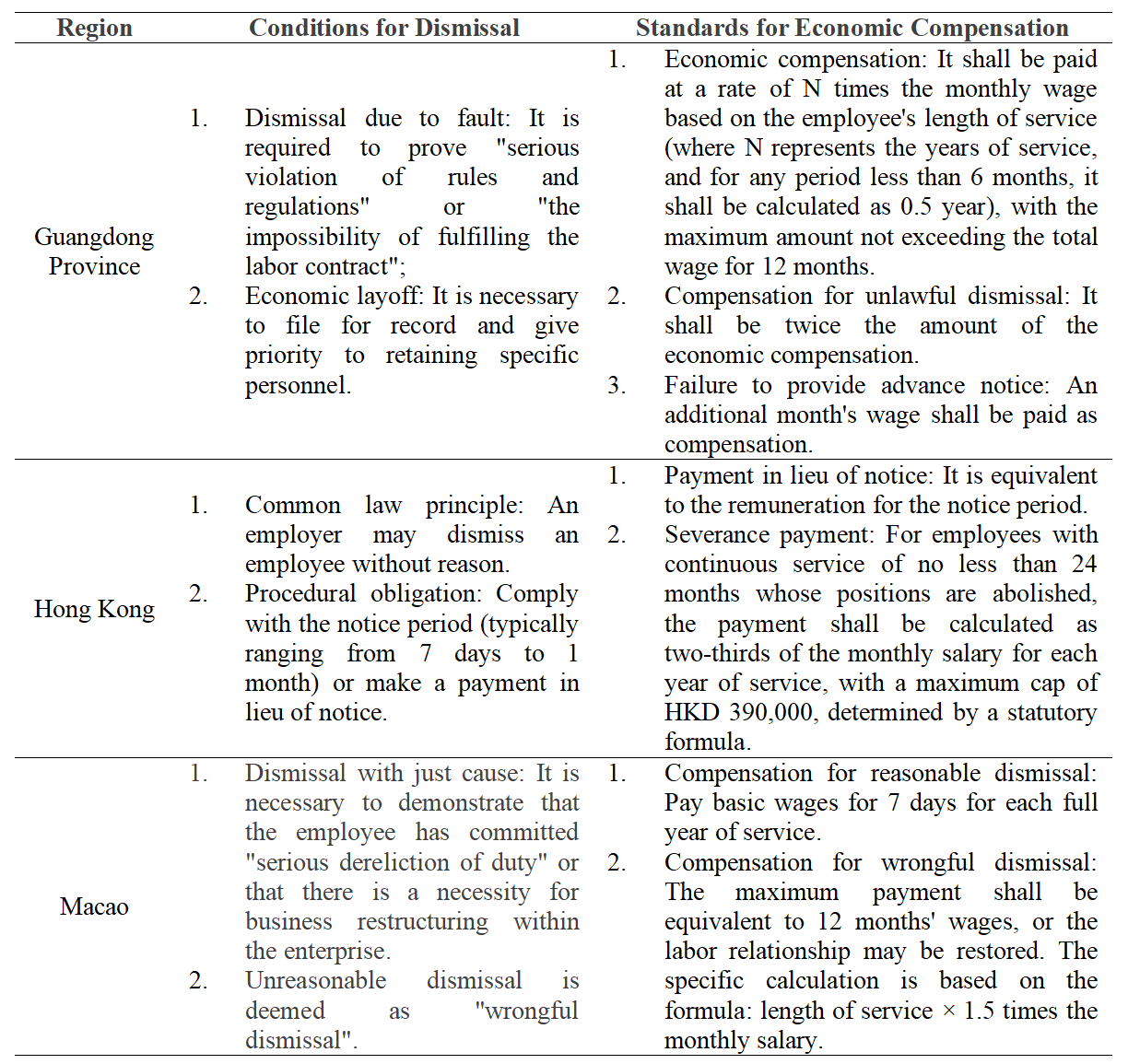
Data source: Compiled based on the laws of the three regions
For human resources management practices, these inconsistencies pose challenges of increased corporate management costs and heightened compliance risks. In cross-border employment scenarios, companies must draft three legally compliant documents for the same employee, with the risk of labor disputes rising due to discrepancies in clause wording. Cross-border enterprises face “dual compliance” pressures when dismissing employees. For vocational college students, current textbooks are largely confined to mainland China's Labor Contract Law, resulting in gaps in their understanding when dealing with cross-border business operations. For instance, the dual-litigation case arising from the dismissal of a Hong Kong executive by a tech company in Zhuhai in 2022 illustrates that HR professionals often lack the computational capability for "dual compliance." Therefore, curriculum reform should incorporate a practical training project on "cost calculation for cross-border dismissals," aiming to teach students how to simultaneously meet the "statutory grounds" stipulated in mainland regulations and the "compensation standards" in Hong Kong and Macao.
Social Security System. The social security system constitutes the core safeguard for workers' fundamental rights and interests, and also serves as a vital component of enterprises' compliance management in labor relations. Significant differences exist among Guangdong, Hong Kong, and Macao in terms of social security system structure, contribution rates, coverage scope, and benefit standards, reflecting distinct orientations in welfare protection philosophies and policy implementation across these regions.
Guangdong Province is built on the foundation of the "Five Insurances and One Housing Fund" system, emphasizing comprehensive coverage and mandatory participation to primarily safeguard against risks related to old-age pensions, medical care, unemployment, work-related injuries, and maternity. In contrast, Hong Kong relies on the Mandatory Provident Fund (MPF) scheme and public medical services, lacking an unemployment insurance program. Macao, on the other hand, adopts a dual-tier social security system, which encompasses both a contributory "Social Security Fund" and provides universal free medical care along with non-contributory "social welfare payments." Table 2 summarizes the key differences in the social security systems among Guangdong, Hong Kong, and Macao.
Table 2
Comparation of Core Differences in Social Security Systems
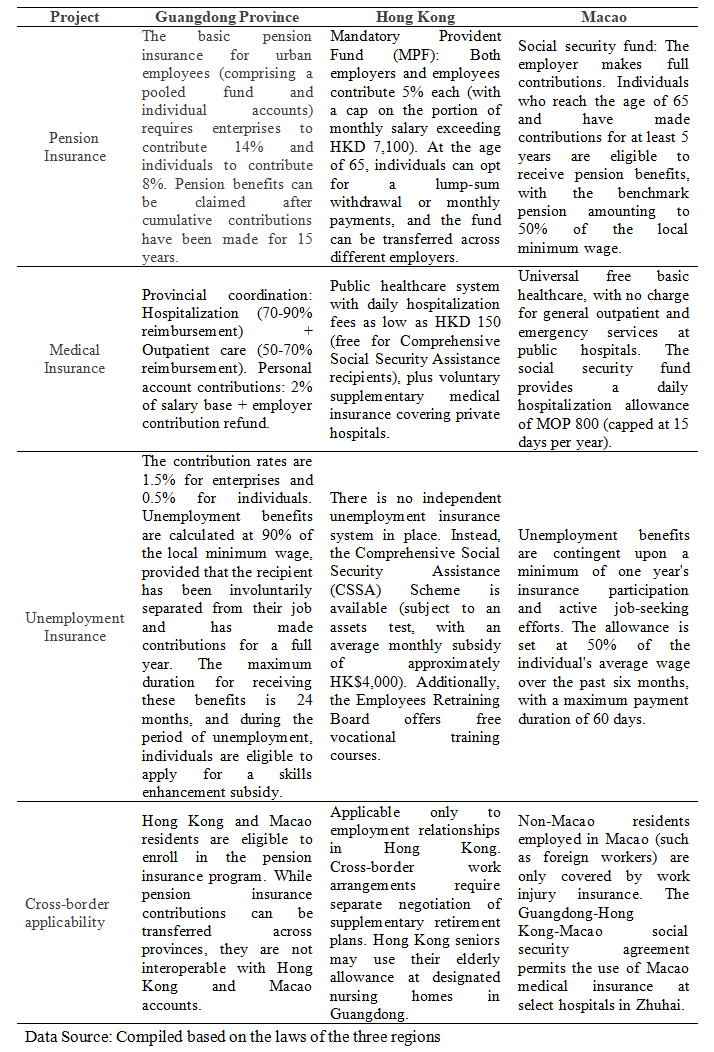
In the process of integrating cross-regional social security systems, enterprises and workers face numerous challenges, primarily manifested in the following aspects: ① Duplicate contributions and loss of benefits due to differences in social security systems. Cross-border workers may end up paying social security contributions in multiple locations and are unable to withdraw their contributions upon leaving a job or returning to work locally. ② Unequal standards for pension and medical benefits directly impact workers' willingness to relocate, with mid-to-high-level talent particularly inclined to choose Hong Kong and Macao regions offering more generous benefits. ③ Insufficient data interoperability and information sharing increase compliance costs for enterprises while exposing employees to risks of information delays and misreporting during multi-location enrollment processes. Vocational education should develop practical training software called the “Greater Bay Area Compensation and Social Security Calculator,” focusing on cultivating students' comprehensive planning capabilities to handle cross-border social security transfers, avoid duplicate payments, and design supplementary commercial insurance plans for expatriate employees. This addresses the current issue where graduates “can only calculate fixed salaries but lack the ability to develop flexible solutions.”
Labor Dispute Resolution Mechanism. The labor dispute resolution mechanism serves as a vital means for maintaining harmonious labor relations and safeguarding the legitimate rights and interests of enterprises. Significant differences exist among Guangdong, Hong Kong, and Macao in dispute resolution procedures, jurisdictional authority, and judicial remedies. Guangdong Province implements a model where labor arbitration serves as a prerequisite procedure, requiring workers to undergo arbitration before filing a lawsuit. Hong Kong adopts a more streamlined process, permitting workers to directly initiate proceedings at the Labor Tribunal. Macao conducts preliminary mediation through the Labor Affairs Office of the Public Security Police Force, with cases failing mediation referred to the Court of First Instance for adjudication. Table 3 summarizes the key differences in the labor dispute resolution mechanisms across Guangdong, Hong Kong, and Macao.
Table 3
Comparison of Differences in Labor Dispute Resolution Mechanisms
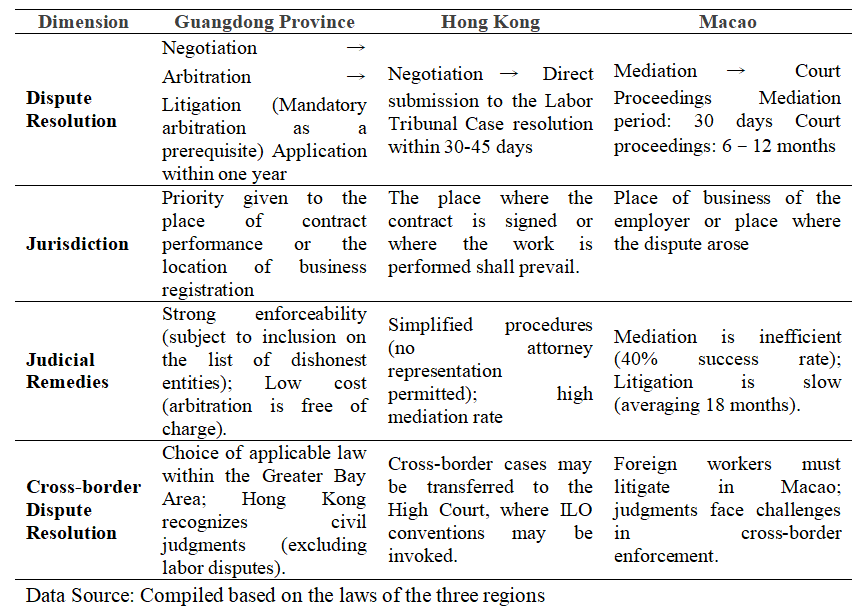
In practice, enterprises face the following primary challenges when handling cross-border labor disputes: ① Jurisdictional conflicts and unclear applicable laws. Differences in jurisdictional determination standards across jurisdictions often trigger disputes between enterprises and employees over jurisdiction. ② Lengthy arbitration and judicial procedures with high costs increase the time expenditure for enterprises in dispute resolution. ③ Significant difficulties in cross-jurisdictional enforcement of judgments create obstacles for enterprises when enforcing rulings across different legal systems. Currently, vocational education curricula rarely cover practical operations such as "foreign-related jurisdictional objections" or "cross-border service of process." Teaching reforms should incorporate mock trial sessions to simulate scenarios involving "litigation in two jurisdictions over a single case," thereby training students in practical skills to mitigate corporate legal risks through the use of mediation, jurisdictional objections, and other strategies at the early stages of disputes.
Wage Payment and Minimum Wage. The wage payment system and minimum wage framework constitute vital components safeguarding workers' fundamental rights. Significant disparities exist among Guangdong, Hong Kong, and Macao in wage payment methods, minimum wage standards, and adjustment mechanisms, reflecting divergent approaches to labor protection principles and policy orientations across the three regions. Guangdong Province's wage payment system emphasizes stability and standardization, enforcing mandatory minimum wage standards and implementing strict penalties for wage arrears. Hong Kong adopts a more flexible approach, permitting daily or weekly wage settlements with a statutory minimum wage calculated on an hourly basis. While Macao implements a monthly minimum wage, certain industries retain significant flexibility in wage payment practices. The core differences among the three regions in wage payment and minimum wage are shown in Table 4:
Table 4
Comparison of Differences in Wage Payment and Minimum Wage Standards
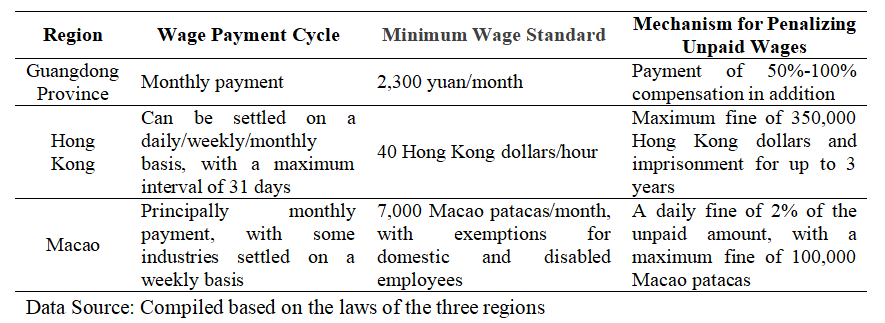
In practice, enterprises generally face challenges arising from differences in wage payment standards and minimum wage policies when managing cross-regional employment. These challenges are mainly reflected in the following aspects: ① The complexity in determining minimum wage standards. There are significant differences in the calculation units and application scopes of minimum wage standards among Guangdong, Hong Kong, and Macao, which can easily cause confusion in cross-border employment scenarios. ② The difficulty in coordinating diverse payment methods. Hong Kong and Macao permit relatively flexible payment methods, which adds operational complexity to enterprise cross-border management. Vocational colleges should incorporate a "cross-regional shift scheduling" module into the Attendance Management course to train students in designing attendance systems that comply with the laws of both regions. Specifically, in the context of flexible employment scenarios, students should learn how to leverage the flexible working hour regulations in Hong Kong and Macao to optimize corporate labor costs while avoiding breaching the legal boundaries in the Mainland.
Working Hours and Overtime Pay. The management of working hours and overtime constitutes a critical aspect of labor relations management. Significant disparities exist among different jurisdictions concerning standard working hours, payment for overtime, and flexibility in working hours. In accordance with the Labor Law, Guangdong Province has clearly stipulated the standard daily working hours, overtime wages, and the system of comprehensively calculated working hours, with an emphasis on the comprehensive protection of workers' rights and interests. Hong Kong adopts a more flexible approach to working hour management but lacks a unified statutory standard for working hours, relying mainly on industry practices and employment contracts. Macao implements a 48-hour workweek and strictly regulates overtime conditions and compensation standards for night work through its Labor Relations Law. Table 5 summarizes the disparities in working hours and overtime pay among Guangdong, Hong Kong, and Macao:
Table 5
Comparation of Differences in Working Hours and Overtime Pay
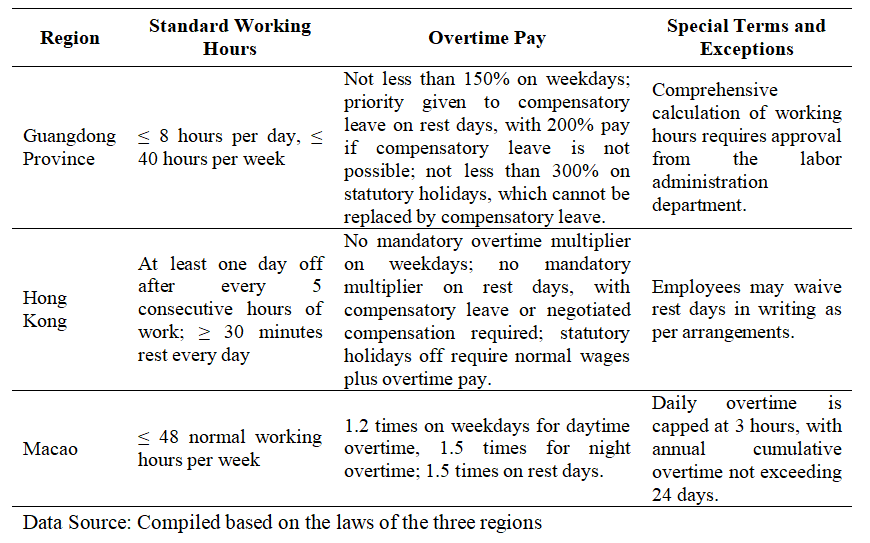
In practice, enterprises face the following challenges in cross-regional working hour management: ① Increased management costs due to differing working hour standards. Significant variations in standard working hour regulations across jurisdictions require enterprises to establish multiple sets of scheduling and attendance management rules, directly leading to higher management costs; ② Complex overtime pay calculations. While Guangdong Province has clear standards for overtime pay, Hong Kong and Macao permit greater contractual freedom. Companies must calculate overtime pay rates separately for each jurisdiction, making errors in the calculation process highly likely and potentially triggering labor disputes; ③ Legal constraints on flexible employment arrangements. Guangdong has established mature systems for comprehensive working hour calculations and flexible working hour arrangements, whereas Macao imposes more restrictions on flexible employment, complicating cross-border employee management for businesses. In teaching, the concept of "multi-calendar shift scheduling management" should be introduced to cultivate students' ability to balance the holiday entitlements of employees from different regions (such as coordinating Easter holidays for Hong Kong employees with adjusted holidays for mainland employees). This represents an advanced level of cross-cultural human resource management competence.
Leave Policy. The leave policy serves as a crucial indicator for assessing the welfare level of laborers and constitutes a key aspect of labor contract management. There are notable disparities among Guangdong, Hong Kong, and Macao in terms of annual leave, statutory holidays, and paid sick leave, particularly with regard to the cumulative criteria for annual leave, the duration and payment ratios of maternity leave and paternity leave.
Guangdong Province has established standardized annual leave and statutory holidays in accordance with national regulations. In contrast, Hong Kong primarily relies on public holidays and grants employers a relatively high degree of autonomy in leave arrangements. Macao's leave policy is comparatively more human-oriented, offering greater protection particularly in terms of sick leave and maternity leave. Table 6 provides a comparative overview of the major holidays in Guangdong, Hong Kong, and Macao.
Table 6
Comparison of Differences in Leave Policy
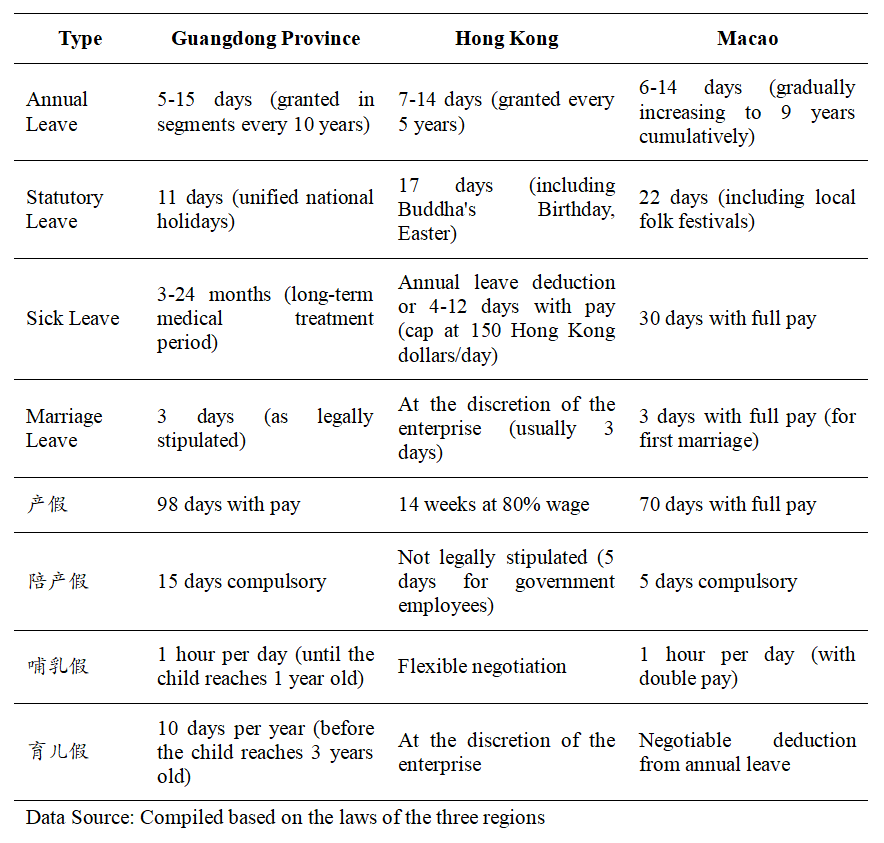
In practice, enterprises face the following key challenges when managing leave systems: ① Conflicting standards for annual leave and sick leave: Significant differences exist across jurisdictions in calculating annual leave entitlements and sick leave pay, often leading to misunderstandings and disputes in cross-border employment contracts. Particularly, variations in sick leave pay rates create substantial uncertainty for enterprises managing leave across regions; ② Differences in statutory holidays complicate scheduling. Hong Kong and Macao have substantially more statutory holidays than Guangdong Province. When scheduling cross-border employees, companies must account for distinct holiday requirements across jurisdictions, frequently resulting in scheduling conflicts or payroll calculation errors; ③ Inconsistent maternity and paternity leave policies: Macao offers more generous maternity and paternity leave provisions, while Guangdong Province and Hong Kong maintain more conservative policies. These disparities create significant gaps in employee rights protection when workers move between jurisdictions, impacting employee satisfaction and corporate labor costs.
Work-Related Injury Recognition and Anti-Discrimination Standards. The criteria for recognizing work-related injuries directly impact the protection of workers' rights and interests as well as the compliance costs for enterprises. There are notable differences among Guangdong, Hong Kong, and Macao in terms of the scope of work-related injury recognition, burden of proof, and compensation standards. Guangdong Province adopts the principle of “burden of proof reversal,” placing the primary burden of proof on employers and incorporating traffic accidents occurring during commutes into the scope of work-related injuries. Hong Kong, however, requires employees to provide evidence of employer negligence or equipment defects. Macao strictly limits coverage to injuries occurring during working hours and within the workplace, and requires submission to the “Health Examination Committee” for medical assessment. Table 7 compares the recognition and benefits of work-related injuries across Guangdong, Hong Kong, and Macao.
Table 7
Comparison of Differences in Work Injury Determination and Benefits
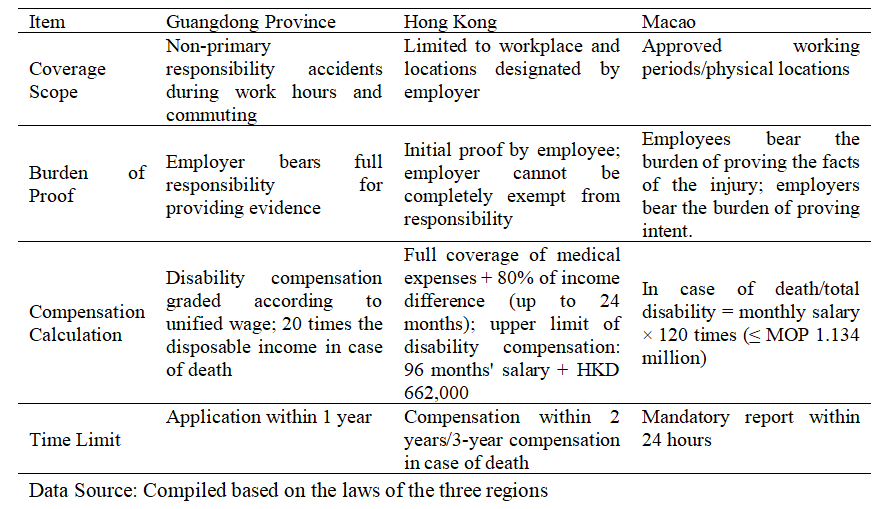
The scope of anti-discrimination systems and the strength of remedies are directly linked to workers' equal employment rights, yet significant disparities exist in legislative levels and judicial practices across Guangdong, Hong Kong, and Macao. Article 3 of the Employment Promotion Law of the People's Republic of China (2015) on the mainland explicitly prohibits discrimination based on ethnicity, race, gender, or religious beliefs, but lacks regulations against implicit discrimination such as based on educational background or age; Hong Kong's Sex Discrimination Ordinance (Cap. 480, 1996) and Disability Discrimination Ordinance (Cap. 486, 1996) adopt a “decentralized legislation + Equal Opportunities Commission oversight” model, extending protections to marital status, sexual orientation, and family medical history; Article 4 of Macao's Framework Law on Employment Policy and Labor Rights merely prohibits “any discriminatory restrictions affecting equal employment opportunities” in principle, with specific enforcement dependent on judicial case-by-case discretion.
Enterprises face the following challenges in cross-regional anti-discrimination management: inconsistent legislative standards and significant disparities in enforcement effectiveness. In cross-regional work injury recognition and compensation, enterprises primarily encounter challenges such as disputes over rights arising from differences in the scope of work injury recognition, resulting in noticeable gaps in rights protection for cross-border workers across different jurisdictions. Courses on recruitment and employee relations management must strengthen the cultivation of “international compliance thinking.” In current teaching practices, students often set inappropriate barriers (such as age or gender restrictions) in simulated recruitment scenarios due to insufficient understanding of Hong Kong's anti-discrimination regulations. Vocational education reforms should incorporate teaching modules like “non-discriminatory job advertisement writing” and “diversity workplace management” to enhance students' professional competence.
Right to Collective Labor. The right to collective labor serves as a crucial legal safeguard for workers to express collective demands and protect their rights and interests. It also functions as a key indicator for measuring labor market fairness and corporate social responsibility. Significant disparities exist among Guangdong, Hong Kong, and Macao in terms of the right to form labor unions, the effectiveness of collective bargaining, and dispute resolution mechanisms. Guangdong Province emphasizes the government's guiding role in trade union activities under the Trade Unions Law of the People's Republic of China (2021), with trade unions possessing legally defined coordination and oversight functions. Hong Kong, adhering to the common law tradition, grants workers the rights to freedom of association and collective bargaining through the Trade Unions Ordinance (Cap. 332, 1971), with negotiated agreements carrying contractual force. While Macao recognizes the right to collective bargaining, its actual implementation rate remains low due to cumbersome administrative procedures. Table 8 provides a summary of the legal frameworks and practical characteristics concerning collective labor rights in Guangdong, Hong Kong, and Macao.
Table 8
Comparation of Differences in Right to Collective Labor
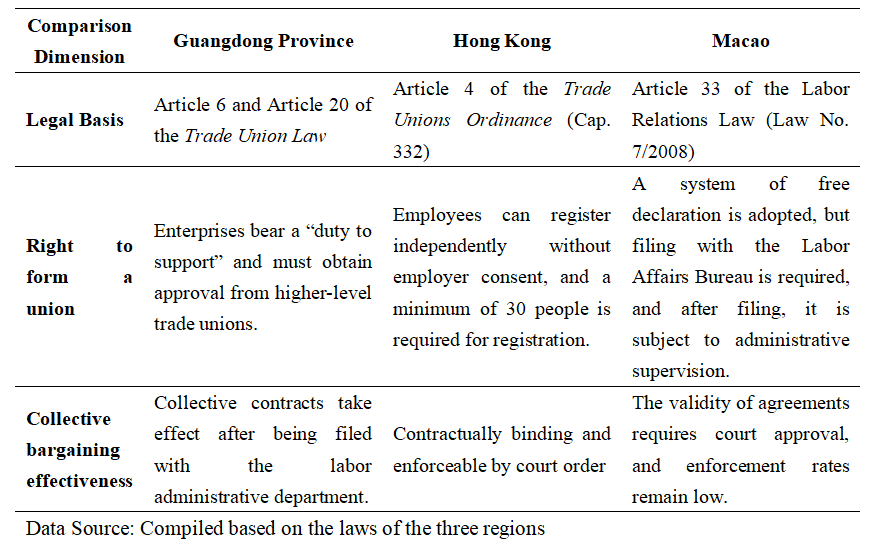
In practical management, enterprises face the following primary challenges in managing cross-regional rights to collective labor: inconsistent standards for union formation require companies to address varying union establishment requirements when operating across different jurisdictions; disparities in the effectiveness of collective bargaining undermine the validity of negotiated agreements; and complex dispute resolution mechanisms heighten legal risks for enterprises in cross-regional labor disputes. Faced with Hong Kong's powerful trade unions and collective bargaining mechanisms, students accustomed to mainland China's union model often find themselves at a loss. Instruction should incorporate training in “collective bargaining techniques” and “labor-management communication skills,” equipping students with the ability to maintain harmonious labor relations within complex industrial settings.
III) The Theoretical Logic of Vocational Education Reform: A Deconstruction from a Law and Economics Perspective
Regional disparities in labor law systems across Guangdong, Hong Kong, and Macao essentially constitute typical “institutional frictions,” whose economic effects are primarily manifested as transaction cost losses in factor mobility. One of the core functions of vocational education is precisely to reduce these institutional transaction costs by supplying human capital equipped with specialized skills.
Coase, in his work The Problem of Social Cost, pointed out that when the transaction costs generated by laws exceed the institutional optimization benefits, the market will suffer from efficiency losses (Coase, 1960). For instance, the mandatory differences in labor contract forms across Guangdong, Hong Kong, and Macao (with Guangdong requiring written contracts while allowing oral agreements in the latter two regions) compel enterprises to incur additional notarization and authentication expenses. These non-productive expenditures generate no substantive value but nonetheless drive up the marginal costs of cross-border employment. From the perspective of vocational education, the high level of such costs largely stems from the "lack of professional talent." When enterprises lack HR professionals with technical skills well-versed in the laws of multiple regions, they have to rely on costly external legal services. By cultivating graduates through vocational education reform who are adept at handling cross-regional compliance matters, enterprises can essentially internalize their external transaction costs into lower human resource management costs, thereby enhancing the operational efficiency of the regional economy.
Becker (1964) emphasized that specific investments in human capital are crucial for achieving productivity improvements. The "incompatibility" of legal systems across the three regions (such as the non-interoperability of social security systems) constitutes a "hidden institutional tax" (North, 1990) that impedes the mobility of talent. The current dilemma lies in the fact that the human capital supplied by the vocational education system in the Greater Bay Area exhibits characteristics of "jurisdictional segmentation"—students proficient in mainland laws are unfamiliar with Hong Kong laws, and vice versa. This mismatch between educational supply and industrial demand has intensified the "regional fragmentation" of the labor market. Therefore, restructuring the curriculum system to cultivate compound talents equipped with "cross-jurisdictional general knowledge" and "practical operational skills" represents the fundamental approach to eliminating implicit institutional barriers and achieving Pareto improvement in human capital across the Greater Bay Area.
In summary, legal conflicts among the three regions are not merely a matter of legal coordination but also the logical starting point for reforming vocational education content. Only through educational innovation can a new “balance point for skills and talent” be established, thereby effectively supporting the integrated development of the Greater Bay Area.
III. Strategies for Vocational Education: Curriculum Restructuring and Practical Training Innovation
The complexity of cross-border labor relations has led to significant disparities among Guangdong, Hong Kong, and Macao in terms of legal application, dispute resolution procedures, and enforcement effectiveness. In the face of this industry-wide challenge, vocational education cannot merely confine itself to teaching within a single jurisdiction. Instead, it must embark on curriculum restructuring and innovate practical training models to cultivate compound technical and skilled talents capable of adapting to the environment of "one country, two systems, and three jurisdictions".
I) Curriculum Restructuring: From “Legal Conflict” to “Teaching Modules”
The legal conflict in cross-border labor relations essentially involves the concurrent application of territorial and personal jurisdiction principles across jurisdictions, which places exceptionally high demands on students' legal logical reasoning.
Firstly, a teaching module on "Identification of Cross-Jurisdictional Legal Conflicts" will be introduced. There is a direct conflict between the rule of "priority of the law of the worker's workplace" established in Article 43 of the Law on the Application of Laws to Foreign-Related Civil Relations on the mainland, the jurisdictional discretion under Hong Kong's common law, and the mandatory application provisions in Article 3 of Macao's Labor Relations Law. A dedicated section on "Conflicts of Law Application" should be incorporated into the Labor Law Practice course. Drawing on the coordination experience outlined in Article 8 of the EU's Rome I Regulation, students will be instructed on how to mitigate risks through "party autonomy" clauses when drafting cross-border contracts. The teaching focus should shift from the mere rote memorization of legal provisions to the cultivation of capabilities in "legal selection and application." For instance, students should be trained to discern when to apply the "law of the place of actual performance" and when to apply the "law of the place of business registration."
Secondly, a practical training course on Digital Legal Skills should be developed. In response to the challenges of difficult evidence collection and mutual recognition in cross-border labor disputes, the industry is actively exploring technological empowerment approaches. By keeping abreast of cutting-edge industry trends, a course titled Digital Compliance in Human Resources Management will be launched. This course will integrate a blockchain-based evidence simulation system, enabling students to practice real-time blockchain storage of cross-border labor contract signings, attendance records, and salary payments. Through this hands-on training, students will develop cross-disciplinary skills that combine technological expertise with legal proficiency. Drawing on the pilot initiatives of "cross-border courts" in Qianhai and Hengqin, a simulated video trial environment will be established within the training laboratory. This setup aims to familiarize students with the "one-stop" cross-border litigation model, enhancing their practical capabilities in assisting enterprises with jurisdictional disputes and conducting remote court proceedings.
Thirdly, a "Greater Bay Area Labor Standards Unified Textbook" should be developed. Given the current situation where "case-by-case breakthroughs" have been made in places like Hengqin and Qianhai, yet systematic standards remain lacking, vocational colleges should collaborate with industry associations across the three regions to compile the Compliance Guide for Labor Employment in the Guangdong-Hong Kong-Macao Greater Bay Area as a school-based textbook. The compilation of this textbook should establish a teaching benchmark that adheres to the principle of "the law of the place of actual performance as the norm, with exceptions favoring worker protection," thereby helping students develop a unified perspective on employment compliance within the Greater Bay Area.
II) Innovation in Practical Training Models: Skill Development Based on Work Processes
To address the legal risks and management costs enterprises face in cross-regional employment, higher vocational colleges should deepen industry-education integration. By transforming corporate management challenges into practical training projects for students, they can achieve precise alignment between talent development and industrial demands.
Firstly, establish a "Guangdong-Hong Kong-Macao Employment Big Data" industry-education integration practical training base. The enterprise demand for constructing cross-regional information platforms presents an opportunity for school-enterprise collaboration. Schools may collaborate with Greater Bay Area human resources service providers to establish practical training bases and integrate authentic corporate compliance systems. Students can leverage AI models to analyze judicial rulings from Guangdong, Hong Kong, and Macao, thereby distilling "compliance red lines." By operating HR SaaS systems for simulated exercises, they can complete closed-loop operations encompassing the entire process of cross-regional contract management, payroll calculation, and social insurance contributions. This approach effectively addresses the persistent educational challenge of "theoretical knowledge without practical operational skills."
Second, implement project-based learning (PBL) under the dual-system contract management model. For industry practices involving a “main contract plus regional supplementary agreements,” conduct project-based learning (PBL). Incorporate authentic corporate case studies and require students to work in groups to design a "contract package for cross-border expatriate employees." Under the guidance of legal consultants (part-time instructors), students must draft supplementary agreements that clearly specify the applicable laws and jurisdictional courts, while also establishing a contract review mechanism. Through practical exercises, the focus is placed on cultivating students' capabilities in risk anticipation and legal document drafting.
Third, implement “1+X” certificate training and social services. Vocational colleges should fulfill their social service functions by addressing corporate internal training needs. Develop vocational skill level certificates such as “Greater Bay Area Compensation Tax Specialist” or “Cross-Border Labor Relations Coordinator.” On one hand, core provisions from the Employment Ordinance and the Labor Relations Act are incorporated into certification assessments; on the other hand, faculty teams are deployed to enterprises to deliver specialized training on legal risk prevention for incumbent HR professionals, achieving an integrated approach to pre-employment training and post-employment development.
Fourth, enhance comprehensive competencies in “compensation design and cross-cultural mediation.” Addressing regional disparities in compensation and benefits, introduce a module on “cross-regional compensation structure design” to teach students how to balance fairness and competitiveness for employees across different areas through “regional supplemental agreements.” A campus-based "Labor Dispute Simulation Mediation Center" should be established to simulate conflict hotspots in cross-regional employment scenarios. Students should be encouraged to apply psychological and legal knowledge to conduct internal mediation at the nascent stage of disputes, thereby cultivating "mediation-oriented" HR professionals with high emotional intelligence and legal acumen.
IV. Conclusion and Prospects
This paper systematically reviews the core differences in the labor law systems of Guangdong, Hong Kong, and Macao, and, from the perspective of vocational education, delves into the new challenges these differences pose to the cultivation of talent in the fields of international business and human resources management. Research indicates that the systemic disparities in the legal systems within the Greater Bay Area not only elevate corporate compliance costs but also highlight the lagging nature of current vocational education in cultivating cross-jurisdictional legal professionals. In response to this issue, this paper proposes a vocational education strategy centered on "curriculum restructuring + practical training innovation." This study breaks through the traditional static analytical paradigm of legal comparison and constructs a vocational education reform logic that follows the sequence of "institutional differences—skill gaps—pedagogical responses."
Future research and practice in vocational education can further deepen in the following directions: ① Promote mutual recognition of qualification frameworks. Drawing on the experience of the European Union, explore a mechanism for mutual recognition of professional qualifications in human resource management among Guangdong, Hong Kong, and Macao, and advance the implementation of a “single certificate valid throughout the Greater Bay Area.” ② Establish a collaborative and shared teaching resource repository. Utilizing digital technologies, promote the establishment of cloud-based teaching resource repositories among institutions and enterprises across the three regions, enabling mutual access to social security data and sharing of legal case studies. ③ Further deepen the cross-regional apprenticeship system by exploring pilot programs for a "Cross-Regional Modern Apprenticeship Scheme" within the Greater Bay Area. This initiative will enable students to acquire theoretical knowledge in Guangdong and subsequently engage in rotational practical training at enterprises in Hong Kong and Macao, thereby achieving a truly seamless integration in the cultivation of talent.
