

1. Introduction
As the uncertainty in the business environment intensifies and market dynamics become more pronounced, aspiring entrepreneurs are set to confront even more formidable challenges. How to identify favorable entrepreneurial opportunities amidst the current volatile market conditions and high environmental dynamism has emerged as a critical research topic (Hao, Chen et al., 2024). The entrepreneurial journey is fraught with challenges and difficulties, necessitating that entrepreneurs possess the ability to bounce back from adversity (Bernard & Barbosa, 2016). This is particularly crucial during unexpected events, such as the Sino-US trade friction. A single piece of news can send ripples across the entire economic market, introducing significant uncertainties and risks for entrepreneurial ventures. Nevertheless, amidst such an environment, numerous opportunities still abound, akin to the "darkness before dawn." For entrepreneurs to sustain operations and thrive under these circumstances, they must swiftly recover from adverse factors and proactively identify and capitalize on favorable opportunities (Xie, Jiang et al., 2025). Therefore, resilience exerts a crucial influence on entrepreneurs' opportunity identification. Fotoki (2018) posits that entrepreneurs endowed with resilience are better equipped to cope with threats and challenges posed by the business environment, thereby achieving entrepreneurial success. Resilience is regarded as a personal trait of entrepreneurs and a catalyst that spurs entrepreneurial actions (Korber & McNaughton, 2018). Consequently, entrepreneurial resilience has garnered widespread attention.
In recent years, entrepreneurial research has witnessed rapid development, with scholars exploring its causal relationships at multiple levels, including the individual, team, and organizational levels. Entrepreneurial resilience has a notable impact on entrepreneurial success, entrepreneurial intention, entrepreneurial performance, and opportunity identification (Ayala & Manzano, 2014; Korber & McNaughton, 2018). From the team perspective, the interaction between the resilience of entrepreneurial teams and adversity plays a crucial role in driving the sustainable development of enterprises (Xie et al., 2025). Entrepreneurial resilience differs from general psychological resilience in that its contextual focus lies in the entrepreneurial process and outcomes (such as opportunity identification, firm survival, and growth), and it emphasizes action and adaptation amidst limited resources and high uncertainty (Li & Ling, 2021). Entrepreneurial resilience can enhance entrepreneurial success, entrepreneurial intention, and entrepreneurial performance in highly uncertain environments (Ayala & Manzano, 2014; Korber & McNaughton, 2018). Although research on entrepreneurial resilience from the perspective of individual traits still has limitations, most studies have demonstrated that entrepreneurial resilience drives entrepreneurial behavior and helps organizations and individuals secure new opportunities (Mo, Wang et al., 2025).At present, research on entrepreneurial resilience primarily focuses on individual traits. During the entrepreneurial process, the resilient traits of entrepreneurs play a crucial role. Entrepreneurs can leverage their entrepreneurial resilience to generate new ideas and create new knowledge through learning when confronted with challenges (Xiang, Zhu et al., 2025). Additionally, entrepreneurial resilience assists entrepreneurs in acquiring relevant resources and seizing opportunities (Wang, Chen et al., 2025). The novel formation mechanisms and boundary conditions of individual entrepreneurial resilience in relation to opportunity identification necessitate further exploration and empirical validation.
Social learning theory (proposed by Bandura) centered around the triadic reciprocal determinism, emphasizes the interaction among individual cognition, behavior, and the environment. It elucidates the acquisition and change of complex social behaviors through mechanisms such as observational learning, imitation, vicarious experiences, and self-efficacy. This study situates entrepreneurial resilience, entrepreneurial learning, and opportunity identification within this framework, transforming emotions amid environmental dynamism into observable cognitive and behavioral changes. Ultimately, these changes lead to a mechanism for opportunity discovery and creation, forming a theoretical chain that is both process-oriented and empirically testable. Individuals' prior knowledge and behavioral experiences enhance the effectiveness of observational learning, while self-efficacy amplifies the demonstrated impact of learning on opportunity identification.
Entrepreneurial learning is an indispensable component of the entrepreneurial process. Exploitative learning revolves around the acquisition of knowledge based on existing knowledge, technologies, processes, and paradigms, emphasizing the refinement, selection, optimization, standardization, and efficient execution of current capabilities. In contrast, exploratory learning is a self-directed approach to exploration and discovery, underscoring the active participation and in-depth contemplation of learners (Ali, 2021). Entrepreneurs are typically highly sensitive to opportunities, and such environmental stimuli may trigger their intense enthusiasm for learning, thereby enabling them to grasp new resources and knowledge (Zhao, Liu et al., 2025). In highly dynamic environments, entrepreneurs with high entrepreneurial resilience are more likely to take proactive actions. Through entrepreneurial learning, they integrate existing knowledge and technologies to refine effective methods, and by engaging in exploration and contemplation, they identify more innovative solutions to seize opportunities (Hu, Gu et al., 2018; Shabbir, Danish et al., 2021). Environmental dynamism may serve as a boundary condition influencing the effect of entrepreneurial resilience on opportunity identification through entrepreneurial learning.
Based on social learning theory, this study investigates entrepreneurs from five domestic entrepreneurial platforms to explore the formation mechanism and boundary conditions of entrepreneurial resilience's impact on opportunity identification. The potential contribution of this research lies in its explanation of the formation of entrepreneurial opportunities from the perspective of entrepreneurial resilience and its examination of the moderating effect of environmental dynamism through entrepreneurial surveys. This approach not only enhances our understanding of how entrepreneurs identify opportunities during the entrepreneurial process and inspires them to do so more effectively but also academically supplements empirical research on entrepreneurial resilience in the field of entrepreneurship.
2. Theories and Hypotheses
2.1 Entrepreneurial Resilience and Opportunity Identification
Entrepreneurial resilience represents an extension and application of the concept of resilience from the field of psychology to the entrepreneurial context. It reflects the level of psychological resilience that entrepreneurs exhibit when confronted with threats and challenges (Corner, Singh et al., 2017; Yao, Li et al., 2021). Therefore, varying levels of individual resilience can lead to different attitudes, behaviors, and performance outcomes. Some individuals are capable of recovering relatively quickly from adverse events, withstanding high levels of disruptive changes, and responding successfully, whereas others may struggle to bounce back promptly and could even spiral into a state of prolonged decline (Zhang & Li, 2020). Entrepreneurial resilience, as a positive form of psychological capital, enables entrepreneurs to better adapt to environmental changes and ignite their entrepreneurial passion, thereby exerting a positive influence on entrepreneurial success. Entrepreneurial resilience refers to the recovery capacity of entrepreneurs in the face of the dynamic process of difficulties and challenges (Bonanno, 2005; Connor & Davidson, 2003; Newman, 2005; Zhang & Li, 2020). Entrepreneurs must promptly challenge their goals and respond to emerging unexpected events. Consequently, entrepreneurial resilience becomes increasingly vital, particularly as it pertains to the ability to function effectively when confronted with entrepreneurial adversities, stress, and uncertain circumstances (Fisher, Maritz et al., 2016). Meanwhile, adversity can, to a certain extent, be regarded as a triggering condition for psychological resilience, while positive adaptation and successful coping can be seen as the positive outcomes of psychological resilience (Chen & Qiu, 2020). The ability to maintain psychological and emotional stability and flexibly adapt to uncertainty after experiencing significant losses and setbacks can assist entrepreneurs in cultivating positive emotions (Corner et al., 2017; Yao et al., 2021).
Opportunities represent unmet market demands, underutilized resources, or capabilities. Opportunity identification delineates the methods by which individuals recognize novel, desirable, and feasible business ideas. It embodies an individual's need to seek out business opportunities and stands as a crucial component of any entrepreneurial process (Ozgen & Baron, 2007; Fultz & Hmieleski, 2021). Only by identifying potential and valuable opportunities can entrepreneurs enhance their likelihood of achieving success (Kuratko, Fisher et al., 2021). Conversely, embarking on entrepreneurship blindly not only fails to achieve entrepreneurial goals but may also lead to severe financial losses. For successful entrepreneurs, the ability to identify and select appropriate entrepreneurial opportunities stands out as one of the most crucial competencies (Tabares, Chandra et al., 2021). Entrepreneurs, by their very nature, are individuals capable of identifying, evaluating, and leveraging their personal capabilities, which provides the foundation for entrepreneurial endeavors (Filser, Tiberius et al., 2023). Entrepreneurs with a high level of entrepreneurial resilience demonstrate a greater tolerance for environmental dynamism. Even when facing adversity, they can respond with a positive attitude (Hayward, Forster et al., 2010). Only through continuous exploration in the market can they identify valuable opportunities and drive ongoing development.
Hypothesis 1: Entrepreneurial resilience has a positive impact on opportunity identification.
2.2 The Mediating Role of Entrepreneurial Learning
Learning serves as a pivotal factor in enhancing entrepreneurship and constitutes a significant driving force behind entrepreneurs' success (Wang & Hsu, 2014). Exploratory learning and exploitative learning exert distinct impacts on entrepreneurs. Exploratory learning represents a process in which entrepreneurs, based on their existing experiences and knowledge, reorganize and create groundbreaking knowledge systems. In contrast, exploitative learning is a gradual process through which entrepreneurs expand and refine their accumulated experiences and knowledge (Politis, 2005). Exploratory learning is crucial for the exploration of new knowledge and learning endeavors, whereas exploitative learning contributes to the enhancement of existing knowledge and learning practices (Dost, Pahi et al., 2019; Lee, Kim et al., 2017; Su, Li et al., 2011).
According to social learning theory, emphasis is placed on the roles of observational learning, imitation, vicarious reinforcement, and self-efficacy in the acquisition of behaviors. Bandura posits that social learning represents an integrated process combining information-processing theory and behavior reinforcement theory. Individuals learn a variety of behaviors through attentive observation and imitation (Wood & Bandura, 1989), thereby constructing their own cognitive frameworks. Entrepreneurs with high entrepreneurial resilience maintain self-efficacy and goal commitment amid adversity. They proactively observe and imitate effective strategies demonstrated by role models, leveraging vicarious reinforcement to reduce trial-and-error costs. Subsequently, they transform adversity experiences into actionable knowledge structures and cognitive frameworks, enhancing their sensitivity to subtle signals and novel combinations. Ultimately, this manifests as superior levels and quality of opportunity identification.
Hypothesis 2: Entrepreneurial learning serves as a mediating relationship between entrepreneurial resilience and opportunity identification.
2.3 The Moderating Role of Environmental Dynamism
The dynamic changes in the environment manifest as an increase in business risks. This represents the objective situation confronting today's entrepreneurs, posing tremendous challenges to their survival and development (Adomako, Opoku et al., 2018). The uncertainty and volatility within the environment can lead to instability and fluctuations in market demand. Entrepreneurs are required to continuously monitor these changes and promptly adjust their products and services accordingly (Hu et al., 2018; Shabbir et al., 2021). In a competitive environment, new competitors emerge incessantly. To survive and thrive amidst fierce competition, entrepreneurs must enhance their competitiveness and continuously commit to innovation and improvement (Do, Budhwar et al., 2022). For entrepreneurs, environmental changes may impose higher psychological stress upon them. When confronting an uncertain future and risks, they are required to shoulder responsibilities and endure pressure (Visser & Scheepers, 2022). Environmental dynamism renders opportunities more intangible, while limited resources persistently impact start-ups' opportunity identification and entrepreneurial performance (Aldrich, Ruef et al., 2020; Yang, Bao et al., 2020).
Entrepreneurship is a complex and tortuous process, with its outcomes influenced not only by the personal factors of entrepreneurs but also by the external business environment (Prince, Chapman et al., 2021). Environmental dynamism stands out as the most prominent feature of a firm's external environment. It is a complex and multidimensional concept that describes situations where the occurrence of future events or changes is difficult to predict, posing inevitable challenges that entrepreneurs must confront during the entrepreneurial process (Brouthers, Brouthers et al., 2002). When there exists a discrepancy between the information available and the information required, entrepreneurs perceive environmental dynamism (Milliken, 1987). In today's era of economic globalization, firms are facing escalating competitive pressures, with markets and customer demands in constant flux, leading to an increasing array of challenges posed by environmental dynamism. In the face of high levels of environmental dynamism, entrepreneurs need to proactively understand customer needs, adapt more flexibly to environmental changes, and make timely decisions. Entrepreneurs with strong entrepreneurial resilience are better equipped to accomplish these tasks (Duchek, 2018). Entrepreneurial resilience refers to the ability to withstand adversity, swiftly adapt to changes, and overcome challenging circumstances. When environmental dynamism is high and markets are rapidly evolving, the information available to entrepreneurs often remains ambiguous. To achieve entrepreneurial success under such conditions, entrepreneurs must promptly adjust their goals and strategies, keeping pace with the ever-changing market dynamics (Bullough & Renko, 2013).
Entrepreneurship necessitates thorough consideration of how environmental changes impact a company's resources and capabilities (Teece, Peteraf et al., 2016). A highly dynamic environment is characterized by escalating uncertainty, where market conditions, political landscapes, and economic situations become unpredictable (Brychko et al., 2023). Due to the difficulties in prediction and control, risks and challenges increase significantly, while potential opportunities in the market may become more concealed and less conspicuous (Yoruk & Jones, 2023). Resilient entrepreneurs are unafraid of difficulties and challenges, exhibiting a high tolerance for uncertainty. They are capable of adapting to the constantly evolving external environment, thereby making more thorough preparations for success. Possessing robust entrepreneurial resilience also entails continuous learning and keen observation of market changes, enabling a deeper understanding of future trends and the identification of demand gaps (Magistretti, Sanasi et al., 2023). In a highly dynamic environment, entrepreneurial learning represents the optimal approach to leveraging entrepreneurial resilience, as persistent learning enables entrepreneurs to uncover new opportunities. While dynamic environments present risks and challenges, they also offer opportunities for innovation and transformation. Consequently, entrepreneurs place greater emphasis on observational learning to identify market opportunities and flexibly adjust their entrepreneurial actions to achieve superior outcomes (Lysova & Khapova, 2019). Based on this, we propose Research Hypothesis 3 and Research Hypothesis 4.
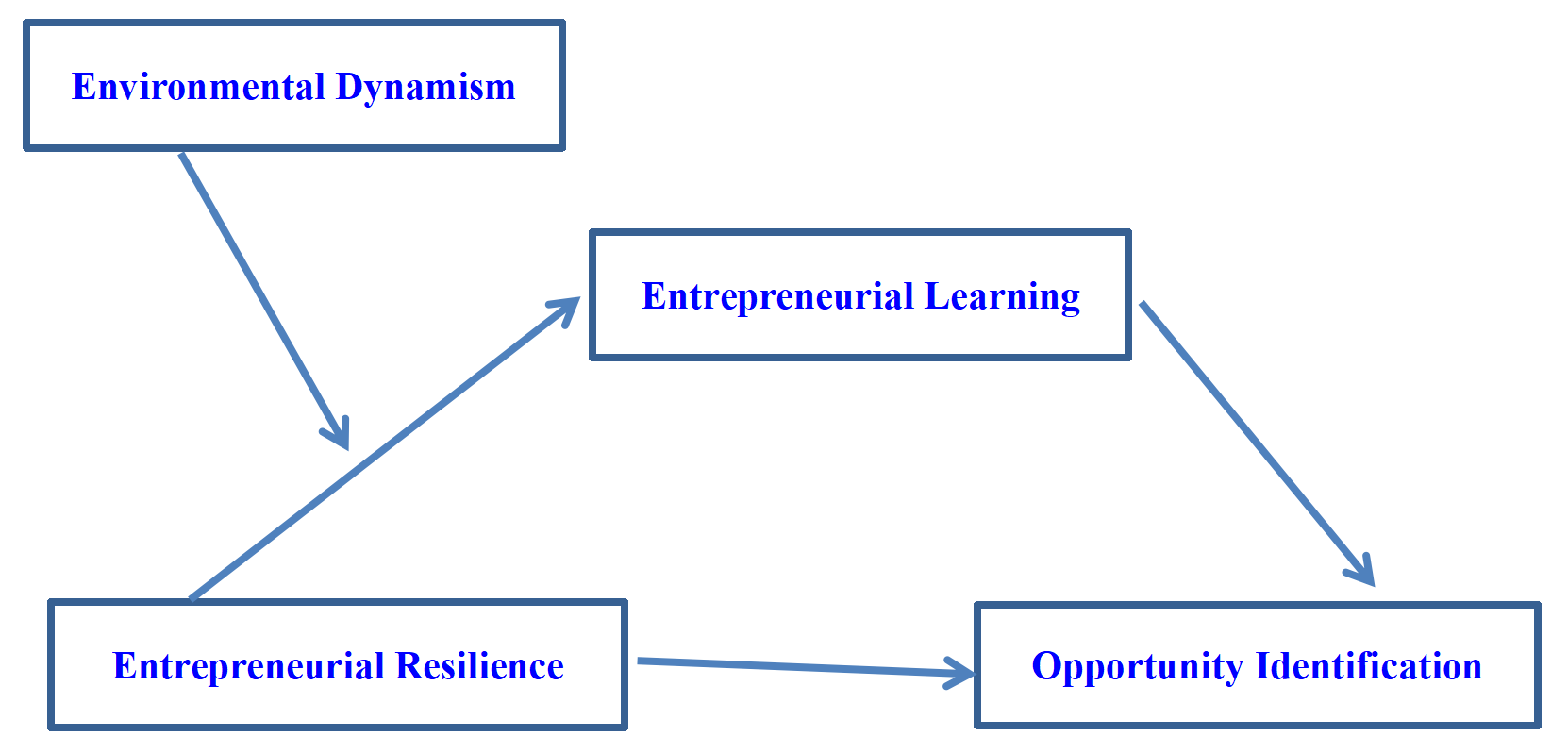
Hypothesis 3: Environmental dynamism moderates the relationship between entrepreneurial resilience and entrepreneurial learning. Specifically, under high levels of environmental dynamism, entrepreneurial resilience exerts a stronger influence on entrepreneurial learning; conversely, under low levels of environmental dynamism, its impact on entrepreneurial learning is weaker.
Hypothesis 4: Environmental dynamism positively moderates the mediating role of entrepreneurial learning in the relationship between entrepreneurial resilience and opportunity identification. That is, under high levels of environmental dynamism, entrepreneurial resilience has a more positive impact on opportunity identification through entrepreneurial learning.
3. Methodology
3.1 Research Approach
This study employs a questionnaire survey method to primarily investigate the impact mechanism and boundary conditions of entrepreneurial learning on opportunity identification. The respondents are all entrepreneurs from domestic youth entrepreneurship platforms, all of whom possess entrepreneurial experience. These entrepreneurs are forging their own business paths on entrepreneurship platforms, which offer a range of corresponding entrepreneurial services, including entrepreneurship policy consultation, entrepreneurial training, industrial and commercial services, patent services, financial services, and tax services. Questionnaires were distributed to entrepreneurs on these platforms via the online survey platform Wenjuanxing. The research methodology adheres to the Helsinki research model. All respondents were fully informed about the purpose and procedures of the study and voluntarily participated in the online survey.
3.2 Participants
All respondents were sourced from domestic entrepreneurship platforms. A total of 465 questionnaires were distributed, with 344 valid responses collected. Among the respondents, 62% were male and 38% were female. Males are more inclined to pursue entrepreneurship. The respondents were predominantly young individuals, with 77.9% of the entrepreneurs being under the age of 30. The majority of the respondents had received higher education, among whom 75.9% held a bachelor's degree or above. The entrepreneurial fields covered a wide range of industries, with manufacturing (29.7%), education and training (11.6%), and the internet sector (10.8%) accounting for relatively high proportions.
3.3 Measurement
The measurement of entrepreneurial resilience (ER) was conducted using a four-item scale adapted by Vaughn G (2004) to evaluate the level of entrepreneurial resilience among entrepreneurs. The specific items include statements such as, "I look for creative ways to alter difficult situations." All items were rated on a 5-point Likert scale (where 1 indicates strongly disagree and 5 indicates strongly agree). In this study, the Cronbach's alpha coefficient for the ER scale was 0.778.
The measurement of entrepreneurial learning (EL) was carried out using a twelve-item scale adapted by Lubatkin (2006) to assess the extent of entrepreneurial learning among entrepreneurs. The specific items include statements such as, "I am committed to improving product quality and reducing costs." All items were rated on a 5-point Likert scale (where 1 indicates strongly disagree and 5 indicates strongly agree). In this study, the Cronbach's alpha coefficient for the EL scale was 0.835.
The measurement of opportunity identification (OI) was conducted using a three-item scale adapted by Ozgen Eren (2007) to evaluate the degree of opportunity identification among entrepreneurs. The specific items include statements such as, "While engaging in daily activities, I notice potential new venture ideas around me." All items were rated on a 5-point Likert scale (where 1 indicates strongly disagree and 5 indicates strongly agree). In this study, the Cronbach's alpha coefficient for the OI scale was 0.623.
The measurement of environmental dynamism (ED) was conducted using a three-item scale adapted by Hoogh (2005) to assess entrepreneurs' perceptions of the degree of environmental dynamism. The specific items include statements such as, "The entrepreneurial environment is highly challenging for me." All items were rated on a 5-point Likert scale (where 1 indicates strongly disagree and 5 indicates strongly agree). In this study, the Cronbach's alpha coefficient for the ED scale was 0.837.
3.4 Statistical Analysis
The data were analyzed using Spss 26.0, Amos 26, and Process 4.0, primarily involving confirmatory factor analysis, correlation analysis, tests for mediating effects, moderation effects, and moderated mediation effects.
4. Results
4.1 Descriptive Statistical Analysis
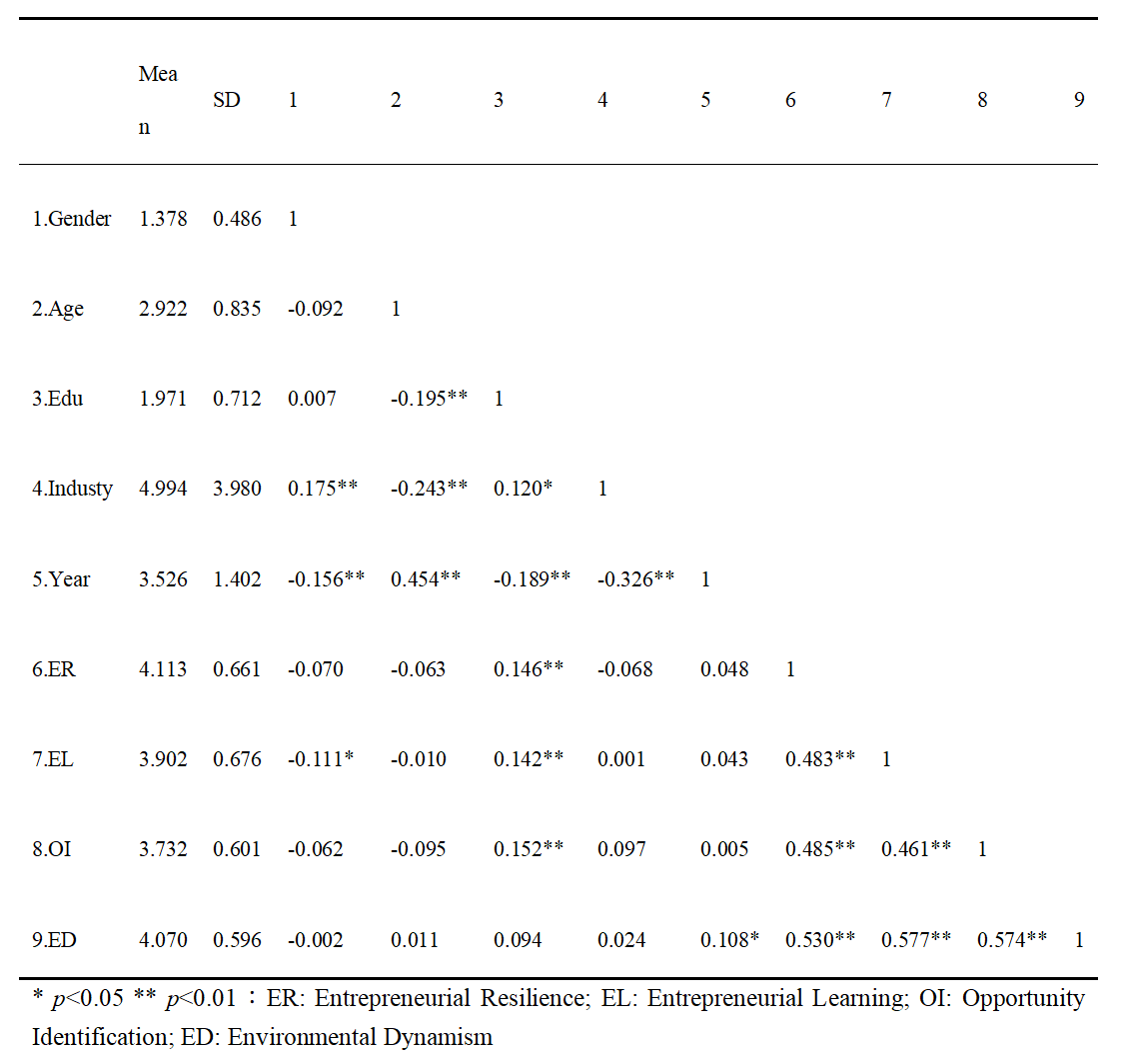
The results of the correlation analysis are presented in Table 1. When controlling for the influences of gender, age, education level, industry, and years of entrepreneurial experience, entrepreneurial resilience exhibits a positive correlation with both entrepreneurial learning (r = 0.483, p < 0.01) and opportunity identification (r = 0.485, p < 0.01). Additionally, entrepreneurial learning demonstrates a positive correlation with opportunity identification (r = 0.461, p < 0.01).
Table 1
Mean, Standard Deviation and Correlation Statistics(n=344)
4.2 Validity Analysis
The measurement scales selected for this study are all classic scales widely used both domestically and internationally. Relevant research reports indicate that these scales for the research variables exhibit good reliability and validity, thereby ensuring the content validity of the scales from the perspective of scientific sourcing. Through confirmatory factor analysis, the study treats the four variables in this paper as the main model, while incorporating other variables into competing models using the following methods, and then compares the goodness-of-fit between the main model and the competing models.
Table 2
Discriminant Validity Test(n=344)
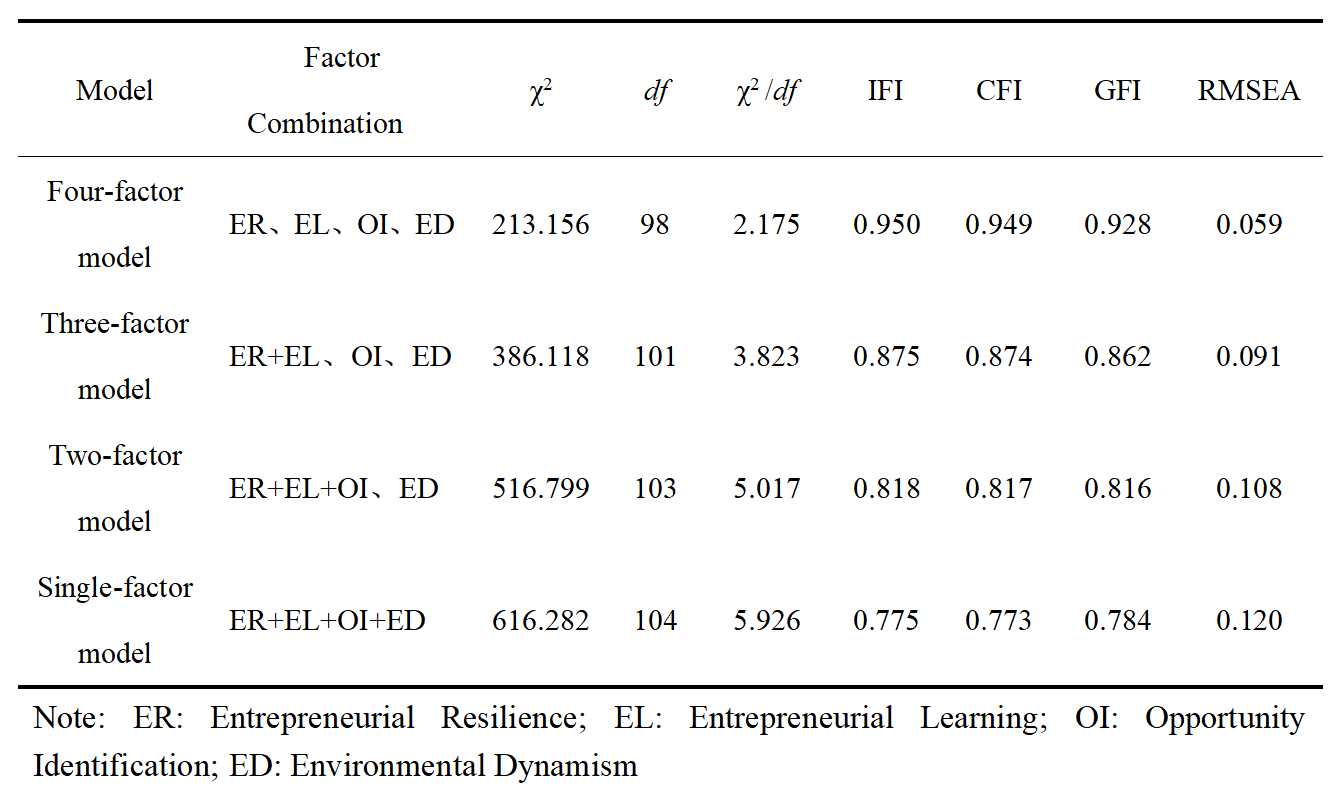
By comparing the goodness-of-fit indicators between the main model and each competing model, it can be observed that the main model, with a χ²/df value of 2.175, outperforms all competing models across all goodness-of-fit indicators. Consequently, the four-factor main model is deemed the optimal choice, indicating that the four variables—entrepreneurial resilience, entrepreneurial learning, opportunity identification, and environmental dynamism—exhibit satisfactory discriminant validity.
4.3 Hypothesis Testing
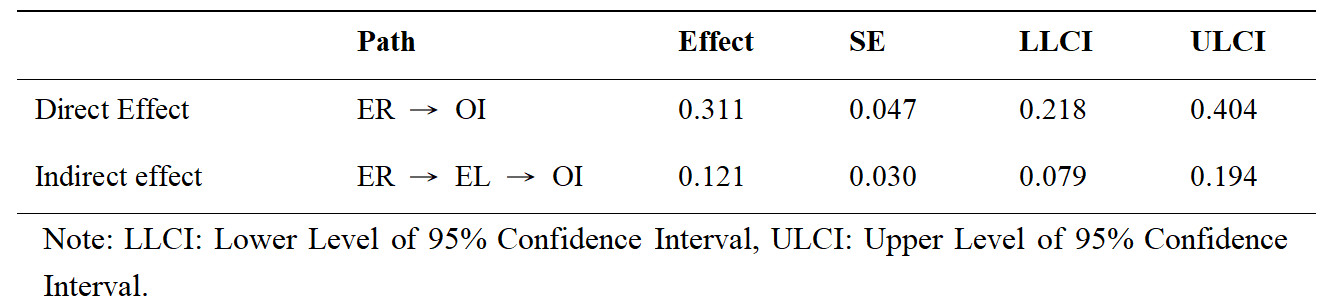
Hypothesis 1 posits that entrepreneurial resilience has a positive impact on opportunity identification. As shown in Table 2, the influence of entrepreneurial resilience on opportunity identification is significant (β = 0.311, SE = 0.047, 95% CI [0.218, 0.404]). Thus, Hypothesis 1 is supported.
Hypothesis 2 proposes that entrepreneurial learning mediates the relationship between entrepreneurial resilience and opportunity identification. As demonstrated in Table 2, the indirect effect of entrepreneurial resilience on opportunity identification through entrepreneurial learning is significant (β = 0.121, SE = 0.030, 95% CI [0.079, 0.194]). Entrepreneurial resilience can facilitate entrepreneurs' identification of opportunities through the mechanism of entrepreneurial learning. Therefore, Hypothesis 2 is supported.
Table 3
Direct Effect and Indirect Effect (n=344)
Hypothesis 3 suggests that environmental dynamism positively moderates the relationship between entrepreneurial resilience and entrepreneurial learning. As shown in Table 3, the interaction term between entrepreneurial resilience and environmental dynamism is significant (β = 0.240, SE = 0.046, 95% CI [0.149, 0.330]). Environmental dynamism plays a positive moderating role in the relationship between entrepreneurial resilience and entrepreneurial learning. In a highly dynamic environment, the impact of entrepreneurial resilience on entrepreneurial learning is stronger. Hypothesis 3 is supported.
Table 4
Moderating Effect and Moderated Mediation Effect (n=344)
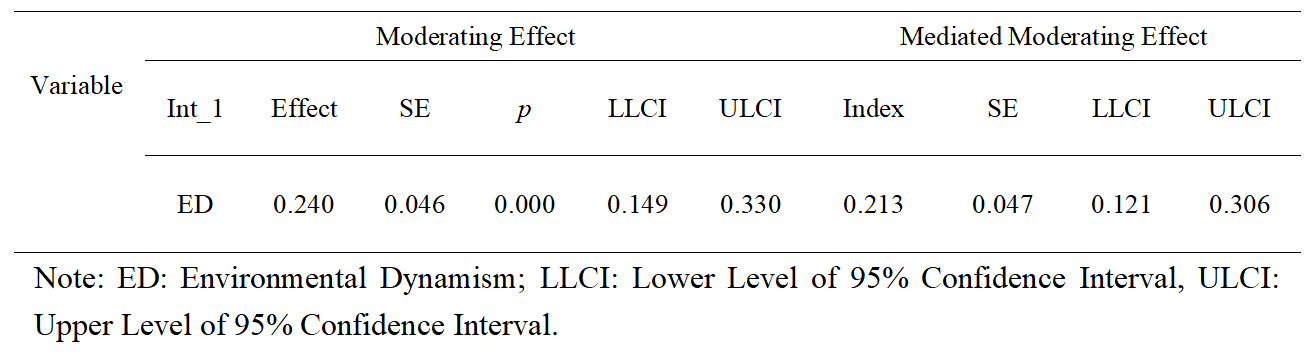
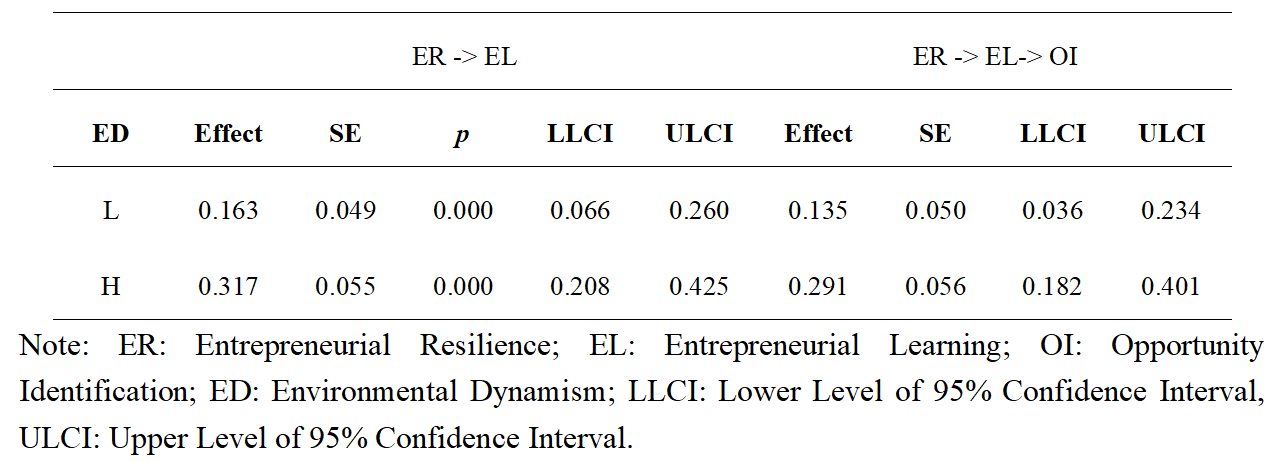
Hypothesis 4 posits that environmental dynamism, through entrepreneurial learning, positively moderates the indirect effect of entrepreneurial resilience on opportunity identification, suggesting that this relationship is stronger under high environmental dynamism. As illustrated in Table 3, the moderating effect of environmental dynamism on the indirect influence of entrepreneurial resilience on opportunity identification via entrepreneurial learning is significant (β = 0.213, SE = 0.047, 95% CI [0.121, 0.306]). Furthermore, as shown in Table 4, when verifying the moderated mediation, it is evident that under high environmental dynamism, entrepreneurial resilience exerts a more positive impact on opportunity identification through entrepreneurial learning. Hence, Hypothesis 4 is supported.
Table 5
Conditional Effect (n=344)
5. Conclusion
Through a survey of 344 members on Chinese entrepreneurial platforms, this study examined the impact mechanism and boundary conditions of entrepreneurial resilience on opportunity identification. The research findings indicate that entrepreneurial learning serves as a mediating factor in the relationship between entrepreneurial resilience and opportunity identification. Specifically, entrepreneurial resilience can enhance opportunity identification through entrepreneurial learning. Moreover, environmental dynamism positively moderates the relationship between entrepreneurial resilience and opportunity identification. Under conditions of high environmental dynamism, both the direct and indirect impacts of entrepreneurial resilience on opportunity identification are stronger. These research hypotheses have been validated.
5.1 Theoretical Implications
Based on social learning theory, this study validates both the direct and indirect impacts of entrepreneurial resilience on entrepreneurs' opportunity identification, highlighting the significant value of entrepreneurial learning for entrepreneurs (Mehrabian & Russel, 1974). This finding is consistent with previous related research (Hu et al., 2018; Shabbir et al., 2021; Fultz & Hmieleski, 2021; Triansyah et al., 2023). Entrepreneurial learning not only enables entrepreneurs to acquire a broad range of knowledge and skills but also provides them with a deeper understanding of the markets and industries in which they operate. This, in turn, helps entrepreneurs better exploit business opportunities and develop strategies for growth (Amankwah-Amoah et al., 2019). Particularly, entrepreneurial learning, characterized by an autonomous learning style involving observation, imitation, and active exploration, can enhance entrepreneurs' capabilities. Meanwhile, entrepreneurial learning theory posits that during the learning process, entrepreneurs are encouraged to actively discover knowledge and cultivate innovative thinking (Ali, 2021). Entrepreneurs can identify and discern business opportunities and venture capital risks through exploitative learning and exploratory learning. As market uncertainty increases, entrepreneurs are required to make rapid decisions and take actions in complex environments, which provides a crucial foundation for the development and growth of enterprises (Shabbir et al., 2021).
Entrepreneurial resilience promotes opportunity identification through entrepreneurial learning, further validating social learning theory. Centered on the triadic reciprocal determinism, which emphasizes the interaction among individual cognition, behavior, and the environment, resilient behaviors drive continuous entrepreneurial learning. In the context of environmental dynamism, entrepreneurs can become more astute at identifying opportunities through learning, thereby enabling spontaneous creative behaviors (Hu et al., 2018). Consequently, the findings of this study reveal that entrepreneurs with entrepreneurial resilience traits are more inclined to observe, learn, experiment with new things, challenge new opportunities, and actively seek high-return opportunities under conditions of high environmental dynamism (Graciano, Lermen et al., 2023).
5.2 Managerial Implications
Entrepreneurs are astute thinkers and observers, adept at recognizing and seizing opportunities. Simultaneously, they are resilient challengers and courageous individuals who not only comprehend risks but also possess the ability to manage them, thereby avoiding excessive losses. When the market experiences significant fluctuations, entrepreneurs tend to adopt a more conservative stance. The research findings indicate that in a highly dynamic environment, entrepreneurs with resilient traits adopt an active learning approach to organize their thoughts and analyze the market. When opportunities arise, they are better positioned to identify them and achieve entrepreneurial success. In the post-pandemic era, as global friction intensifies and consumer habits and people's understanding of life undergo profound changes, entrepreneurs can no longer rely solely on past experiences to judge newly emerging markets. Both the external and internal environments have undergone concurrent changes. Under such circumstances, only entrepreneurs with entrepreneurial resilience can persist in learning, continuously observe, and think critically amidst adversity and a dynamic environment. Once they identify a new direction and secure new resources, they can promptly discern valuable opportunities and achieve entrepreneurial success. Therefore, entrepreneurial resilience represents a crucial capability in today's market environment, enabling entrepreneurs to seize opportunities and realize their entrepreneurial goals.
6. Limitations and Future Research
This study has the following limitations: The use of self-assessment scales in this research may lead to an overestimation of the impact of entrepreneurial resilience on opportunity identification. In future studies, the risk of common method bias can be further controlled by employing diverse research methods, such as considering paired observers, conducting in-depth interviews, and experimental research (Podsakoff, MacKenzie et al., 2003). All data in this study were collected from members of Chinese entrepreneurial platforms. Given that Chinese culture places a strong emphasis on stability and risk aversion, with attitudes that differ markedly from those in many other countries (Rohrmann & Chen, 1999), the findings of this study may possess certain unique implications.
Future research could delve into the impact mechanisms and boundary conditions of entrepreneurial resilience on opportunity identification among entrepreneurs from diverse backgrounds. Cross-cultural comparative studies would contribute to a more comprehensive explanation of entrepreneurial opportunity identification. Furthermore, this study solely elucidates the formation of opportunity identification from the perspective of entrepreneurial resilience within entrepreneurial behavior. Given that the formation mechanisms of entrepreneurial emotions and risk preferences as individual traits are intricate, discussions from multiple angles—including macro-environmental factors, organizational climate, leadership traits, and personal characteristics—would foster a deeper understanding of entrepreneurial resilience.
